- +86-311-66792193
- sales@apmwiremesh.com

|
||||||||
 |
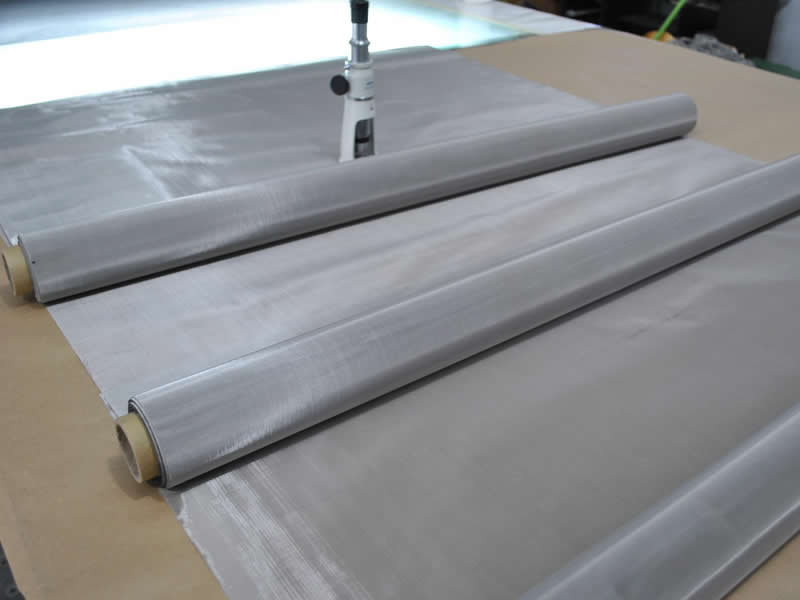
Material: Stainless Steel 302,304,316,304L,316L,310,430 etc.
Woven pattern: Plain Weave, Twill Weave, Plain Dutch Weave, Twill Dutch Weave, Reverse Plain Dutch Weave.
Application: Use for mining, chemical industry. food industry and pharmaceutical industry because of the charac-teristics of wear-resisting,heat-resisting. acid-resisting and corrosion resisting.
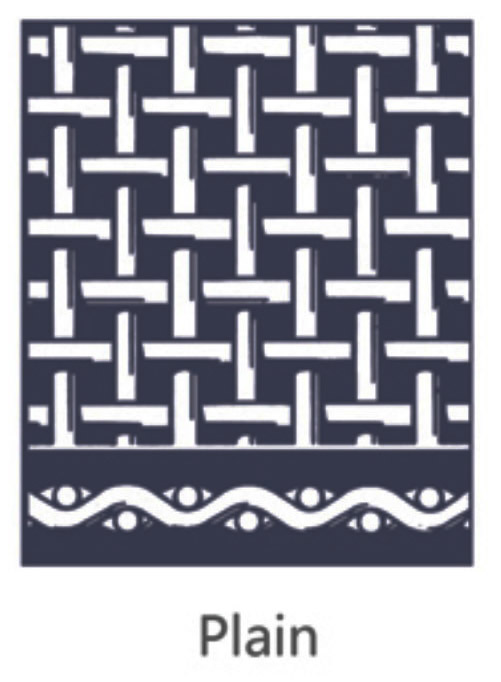
Plain Weaving
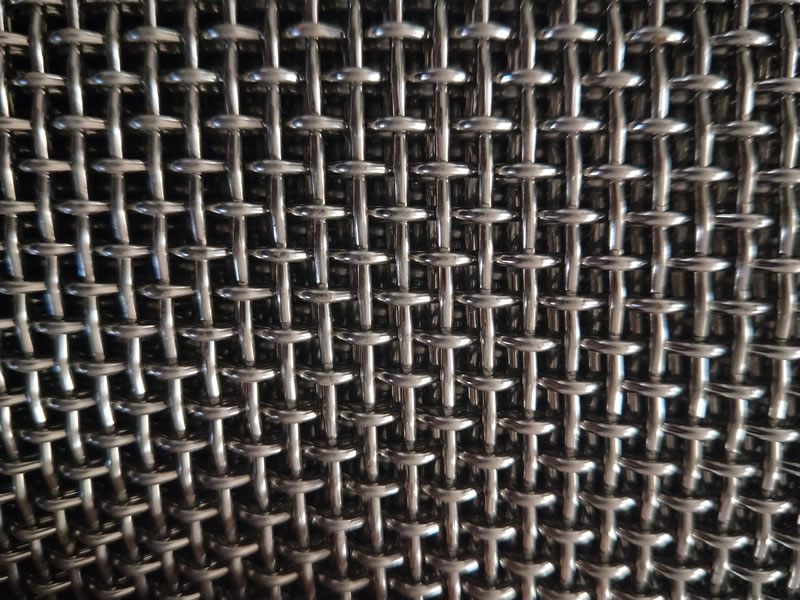
The Plain Wire Cloth Weaving is the most common wire cloth used and it is one of the simplest wire cloths. The plain wire cloths are not crimped before weaving, and each warp wire passes over / under the wires running through the cloth at 90 degree angles.
Warp and weft wire diameters are generally the same. Used for the majority of commercial applications and for filtration where a high flow rate is required.
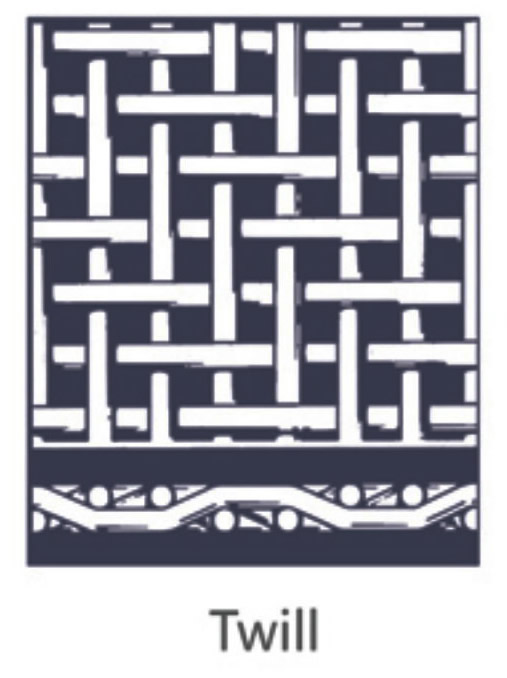
Twilled Weaving
Each weft wire passes alternately above and below every successive pair of warp wires and vice versa. This weave permits a heavier wire diameter to be used than would be possible in a plain weave with similar mesh count. This ability allows the application of this wire cloth for greater loads and finer filtration.
| Mesh | SWG | Wire ø (mm) | Aperture Size mm | Micron | Open Area % | Mesh | SWG | Wire ø (mm) | Aperture Size mm | Micron | Open Area % | ||||||||||||
| 2 | No.12 No.18 | 2.60 1.20 | 10.10 11.50 | 10100 11500 | 63.20 82.10 | 50 | No.34 No.37 | 0.22 0.17 | 0.29 0.34 | 290 340 | 32.14 43.40 | ||||||||||||
| 3 | No.12 No.18 | 2.60 1.10 | 5.87 7.37 | 5870 7370 | 48.00 75.70 | 60 | No.35 No.38 | 0.20 0.14 | 0.22 0.28 | 220 280 | 27.83 44.80 | ||||||||||||
| 4 | No.12 No.20 | 2.50 0.90 | 3.85 5.45 | 3850 5450 | 36.76 73.70 | 70 | No.37 No.38 | 0.17 0.14 | 0.19 0.22 | 190 220 | 28.30 37.72 | ||||||||||||
| 5 | No.15 No.20 | 1.80 0.90 | 3.28 4.18 | 3280 4180 | 41.70 67.70 | 80 | No.38 No.41 | 0.14 0.11 | 0.18 0.21 | 180 210 | 31.25 42.70 | ||||||||||||
| 6 | No.16 No.22 | 1.50 0.70 | 2.73 3.53 | 2730 3530 | 41.69 69.70 | 90 | No.39 No.42 | 0.13 0.10 | 0.15 0.18 | 150 180 | 29.10 41.69 | ||||||||||||
| 7 | No.18 No.22 | 1.10 0.70 | 2.53 2.93 | 2530 2930 | 48.56 65.10 | 100 | No.40 No.43 | 0.12 0.09 | 0.13 0.16 | 130 160 | 27.80 41.69 | ||||||||||||
| 8 | No.18 No.23 | 1.10 0.55 | 2.08 2.63 | 2080 2630 | 42.70 68.36 | 120 | No.42 No.45 | 0.10 0.07 | 0.11 0.14 | 110 140 | 27.83 44.80 | ||||||||||||
| 10 | No.18 No.25 | 1.10 0.45 | 1.44 2.09 | 1440 2090 | 32.14 67.70 | 150 | No.44 No.46 | 0.08 0.06 | 0.089 0.109 | 89 109 | 27.80 41.69 | ||||||||||||
| 12 | No.19 No.26 | 1.00 0.45 | 1.12 1.66 | 1120 1660 | 27.83 62.00 | 165 | No.45 | 0.035 | 0.119 | 119 | 59.70 | ||||||||||||
| 14 | No.22 No.28 | 0.70 0.35 | 1.11 1.46 | 1110 1460 | 37.70 65.10 | 180 | No.47 No.48 | 0.05 0.06 | 0.090 0.080 | 90 80 | 40.70 33.00 | ||||||||||||
| 16 | No.25 No.33 | 0.45 0.25 | 1.14 1.34 | 1140 1340 | 51.34 71.00 | 200 | No.47 No.48 | 0.050 0.040 | 0.077 0.087 | 77 87 | 36.80 46.90 | ||||||||||||
| 18 | No.25 No.35 | 0.50 0.20 | 0.91 1.39 | 910 1390 | 41.60 76.40 | 230 | No.47 No.48 | 0.040 0.035 | 0.070 0.075 | 70 75 | 40.00 35.80 | ||||||||||||
| 20 | No.27 No.33 | 0.40 0.24 | 0.87 1.03 | 870 1030 | 46.90 65.78 | 250 | No.47 No.48 | 0.050 0.040 | 0.051 0.061 | 51 61 | 25.00 35.80 | ||||||||||||
| 24 | No.26 No.30 | 0.45 0.30 | 0.61 0.76 | 610 760 | 33.10 51.34 | 300 | No.48 No.49 | 0.040 0.030 | 0.044 0.055 | 44 55 | 26.80 41.90 | ||||||||||||
| 25 | No.30 | 0.30 | 0.72 | 720 | 49.66 | 325 | No.48 No.49 | 0.035 0.030 | 0.043 0.048 | 43 48 | 30.30 37.80 | ||||||||||||
| 28 | No.28 No.30 | 0.35 0.30 | 0.56 0.61 | 560 610 | 37.80 44.90 | 350 | No.48 No.49 | 0.035 0.030 | 0.037 0.043 | 37 43 | 25.70 34.70 | ||||||||||||
| 30 | No.28 No.35 | 0.35 0.20 | 0.50 0.64 | 500 640 | 34.60 56.60 | 400 | No.49 No.50 | 0.030 0.025 | 0.034 0.039 | 34 39 | 28.20 37.10 | ||||||||||||
| 40 | No.32 No.36 | 0.25 0.18 | 0.38 0.46 | 380 460 | 36.76 51.34 | 500 | No.50 | 0.025 | 0.026 | 26 | 26.00 | ||||||||||||
Plain Dutch
Woven as a plain weave but with the warp wires of greater diameter than the weft wires. The weft wires are woven tightly together producing a strong cloth whilst allowing a good flow rate.
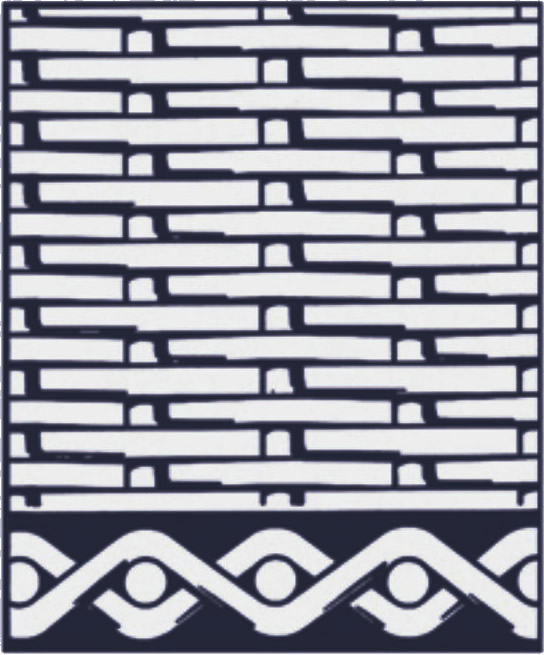
| Mesh Wrap/Weft | Wire Ø Wrap/ weft (mm) | Absolute Particle Retention (Microns) | Nominal Particle Retention (Microns) |
| 8x85 | 0.356/0.32 | 330-350 | 250 |
| 10×70 | 315-335 | ||
| 12x64 | 0.609/0.419 | 280-300 | 200 |
| 10×90 | 270-290 | ||
| 14x88 | 0.508/0.330 | 220-240 | 150 |
| 12×95 | 240-260 | ||
| 14×110 | 220-240 | ||
| 16×120 | 200-210 | ||
| 20×150 | 0.249/0.178 | 170-190 | 100 |
| 20×160 | 160-180 | ||
| 22×140 | 140-170 | ||
| 24×110 | 0.381/0.254 | 112-125 | 80 |
| 30×150 | 0.228/0.178 | 95-110 | 63 |
| 40×200 | 0.178/0.139 | 75-80 | 56 |
| 50×280 | 71-75 | 45 | |
| 50×250 | 0.139/0.114 | 56-63 | 40 |
| 80×400 | 0.127/0.076 | 36-45 | 45 |
Reverse Plain Dutch
This is the reverse of the Plain Hollander (Dutch) weave. The weft wires are of greater diameter than the warp wires, and consequently the warp mesh count is greater than the weft mesh count. This cloth is extremely strong, is easily cleaned and has a high flow rate.
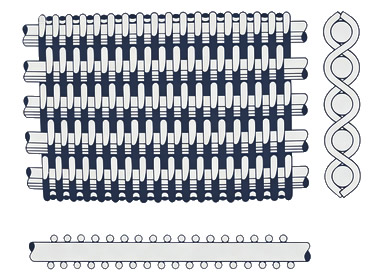
| Reverse Dutch Weave Belt | ||
| Mesh | Wire Dia. (mm) | We1ght (kgs/m²) |
| 72×15 | 0.45x0.55 | 4.8 |
| 120×16 | 0.35x0.45 | 4.485 |
| 132×18 | 0.35x0.45 | 4.95 |
| 152×24 | 0.30x0.45 | 4.635 |
| 160×17 | 0.27x0.45 | 3.777 |
| 170×17 | 0.27x0.45 | 3.9586 |
| 180×19 | 0.26x0.45 | 4.0 |
| 200×40 | 0.17x0.27 | 2.17 |
| 260×40 | 0.15x0.25 | 2.09 |
| 325×40 | 0.13x0.24 | 1.95 |
Twilled Dutch
Similar to Plain Dutch weaving, except that the weave is twilled, allowing a double layer of weft wires. This cloth is "light tight", has a very smooth surface, is strong, but has a restricted flow rate. There are no apertures in the true sense of the word as the filtrate follows a sinuous path through the depth of the wire cloth. Also referred to as Micromesh and is used for critical filtration applications often under high pressure.
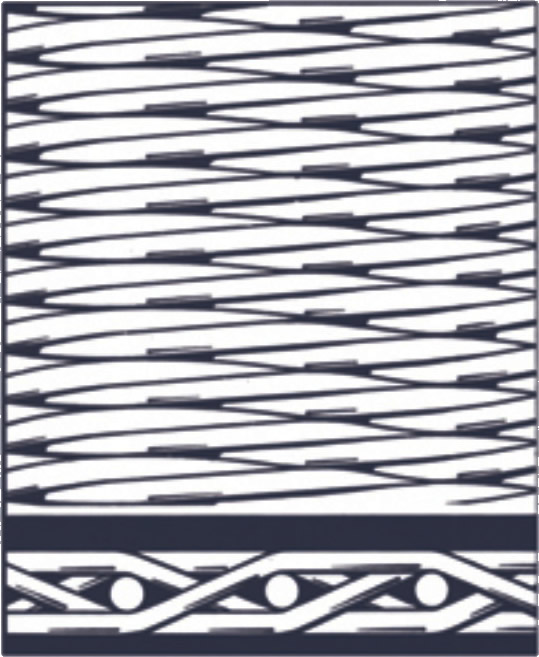
| Mesh Wrap/ Weft | Wire Ø Wrap/ weft (mm) | Absolute Particle Retention (Microns) | Nominal Particle Retention (Microns) |
| 20×250 | 0.249/0.200 | 110-120 | 100 |
| 30×250 | 100-112 | 90 | |
| 30×360 | 0.249/0.152 | 95-106 | 80 |
| 40×560 | 0.178/0.102 | 71-80 | 50 |
| 120×400 | 0.102/0.066 | 50-55 | 40 |
| 120×600 | 0.102/0.063 | 40-45 | 30 |
| 80x700 | 0.102/0.076 | 34-36 | 25 |
| 200x600 | 0.061/0.046 | 28-32 | 20 |
| 165x800 | 0.071/0.051 | 24-26 | 15 |
| 165×1100 | 20-21 | 12 | |
| 165×1400 | 0.071/0.041 | 16-18 | 10 |
| 200×1400 | 0.071/0.041 | 11-13 | 5 |
| 250×1400 | 0.056/0.041 | 11-12 | 4 |
| 325×2300 | 0.038/0.025 | 8-9 | 2 |
| 450x2750 | 0.025/0.021 | 6-7 | <1 |
| 500×3500 | 0.025/0.015 | 5 | <1 |
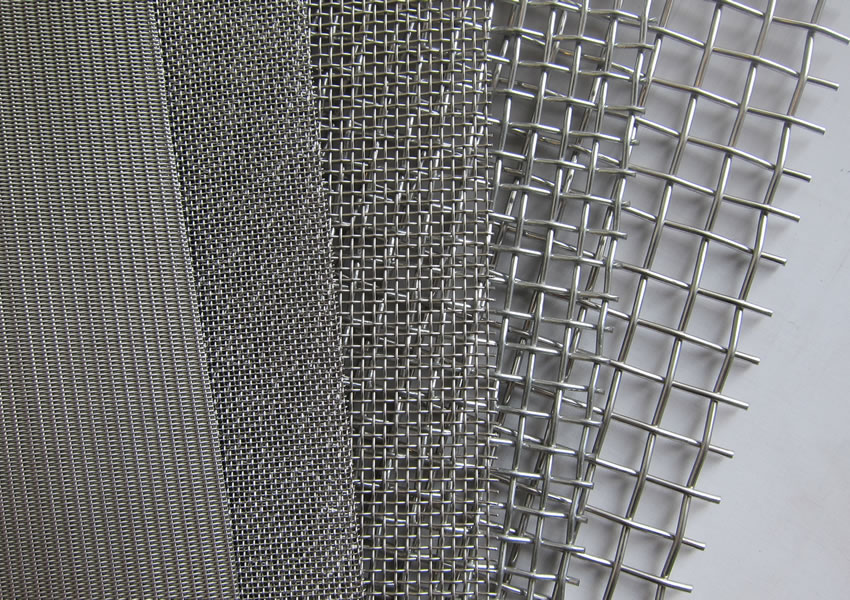
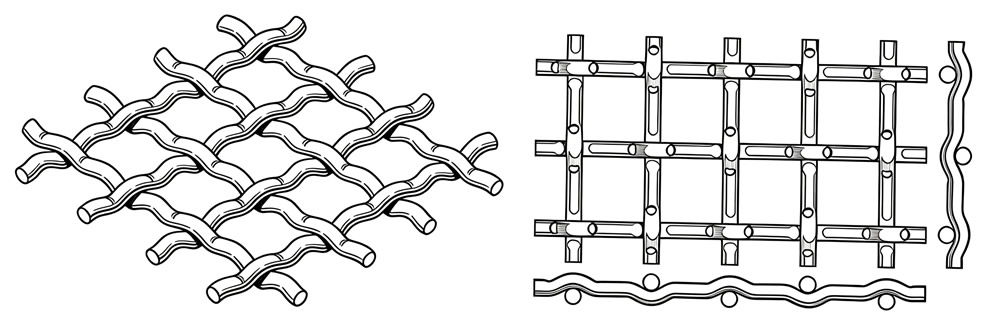
Crimped Mesh
Crimped wire mesh is widely used in mining and oil industrial.
Opening size: 2 mm to 100 mm
Wire diameter: 0.7 mm to 12 mm
Type as the following details:
| AISI Type | Chemical Composition (%) | |||||||||||
| C Max. | Mn Max. | Cr | MO | Ni | Fe | S1 Max. | P Max. | S Max. | AI | Cu | Zn | |
| 304 | 0.08 | 2.0 | 18.0-20.0 | - | 8.0-10.5 | BAL | 1.0 | 0.045 | 0.03 | - | - | - |
| 304L | 0.03 | 2.0 | 18.0-20.0 | - | 8.0-12.0 | BAL | 1.0 | 0.045 | 0.03 | - | - | - |
| 316 | 0.08 | 2.0 | 16.0-18.0 | 2.0-3.0 | 10.0-14.0 | BAL | 1.0 | 0.045 | 0.03 | - | - | - |
| 316L | 0.03 | 2.0 | 16.0-18.0 | 2.0-3.0 | 10.0-14.0 | BAL | 1.0 | 0.045 | 0.03 | - | - | - |
| 317 | 0.08 | 2.0 | 18.0-20.0 | 3.0-4.0 | 11.0-15.0 | BAL | 1.0 | 0.04 | 0.03 | - | - | - |
| 321 | 0.08 | 2.0 | 17.0-19.0 | - | 9.0-12.0 | BAL | 1.0 | 0.045 | 0.03 | - | - | - |
| 330 | 0.08 | 2.0 | 17.0-20.0 | - | 34.0-37.0 | BAL | 0.75-15 | 0.03 | 0.03 | - | 1 | - |
| 347 | 0.08 | 2.0 | 17.0-19.0 | 0.75 | 9.0-13.0 | BAL | 1.0 | 0.045 | 0.03 | - | 0.50 | - |
| 410 | 0.15 | 1.0 | 11.5-13.5 | - | - | BAL | 1.0 | 0.045 | 0.03 | - | - | - |
| 430 | 0.12 | 1.0 | 16.0-18.0 | - | - | BAL | 1.0 | 0.045 | 0.03 | - | - | - |